Opening reception: Wednesday, April 15, 6PM – 8PM
(Free access)
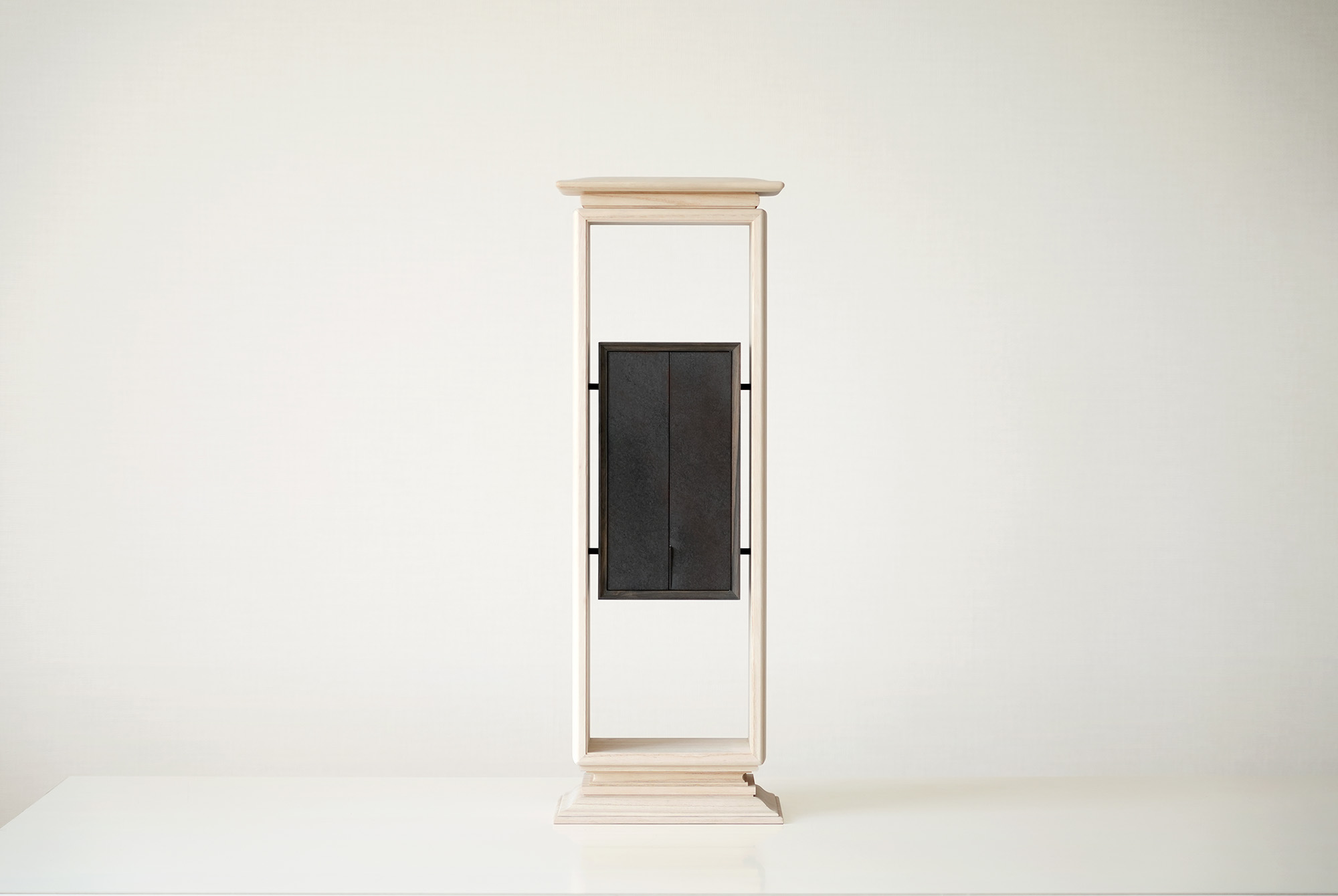
OGATA presents, in collaboration with ZUSHIYA, a series of exhibitions entitled HAKO, dedicated to the Japanese culture of containers with a spiritual dimension.
These containers derive from the motif of the zushi, a box originally intended to house something precious – both a physical and spiritual vessel to which one may entrust the soul. As Buddhism was introduced to Japan in the 6th century, zushi spread from the following century as cases designed to hold important objects such as Buddhist statues, relics, sutras, or memorial tablets. Among the most famous examples is the Tamamushi no zushi, preserved at Hōryū-ji Temple in Nara, dating from the Asuka period and designated a National Treasure. Over time, particularly since the 1920s, as lifestyles and domestic environments have evolved significantly, the ancestral practice of turning to one’s ancestors and offering prayers has gradually diminished.
This exhibition proposes to rethink the zushi as a simple “box” (hako in Japanese): a physical and mental space capable of holding objects, accommodating our thoughts and emotions, and encouraging a contemplative attitude. By revisiting an ancestral culture supported by numerous artisanal skills, OGATA and ZUSHIYA invite a free and renewed use of a distinctly Japanese motif, in the pursuit of a broader, everyday spirituality.
Neither strictly religious nor purely decorative, the zushi exists at the intersection of design, craftsmanship, and intimacy. It opens a space of calm and memory – a precious pause within daily life.
This second edition presents receptacles designed by contemporary Japanese designers and artists: postwar Japanese design master Shigeru Uchida (1943–2016), the prolific artists Mai Miyake and Yasuyo Izumi, as well as Shinichiro Ogata, founder of OGATA Paris.

Shigeru Uchida, Zushi Type D, H200 × W900 × D150, Body: bird’s-eye maple / Door: aluminum / Finish: matte finish.
In addition to the wood typically used in traditional receptacles, these contemporary creations incorporate metal as well as paper, requiring distinctive artisanal production techniques. While reflecting contemporary design aesthetics and a rich palette of colors, these receptacles continue to function as focal points of spiritual attention within living spaces.
About the artists
Shigeru Uchida (1943–2016)
Born in Yokohama, Shigeru Uchida was a major figure in postwar design. Trained at Kuwasawa Design School – where he later became director – he founded Studio 80 in 1981 and developed a wide-ranging practice spanning interior architecture, furniture, industrial design, and urban planning. He realized numerous large-scale projects, including boutiques for Yohji Yamamoto, the Kobe Fashion Museum, and Hotel Il Palazzo in Fukuoka. His work was shaped through an international network of collaborations alongside figures such as Shirō Kuramata, Ettore Sottsass, Aldo Rossi, and Gaetano Pesce. His works are now held in major institutions such as the Metropolitan Museum of Art and the San Francisco Museum of Modern Art.
Mai Miyake
Born in Tokyo in 1975, Mai Miyake has been active on the international art scene since the 2000s. She is recognized as a singular and influential figure in contemporary Japanese art, combining creativity, experimentation, and critical reflection. She studied at the École nationale supérieure des beaux-arts de Paris, where she developed a conceptual and transdisciplinary practice drawing from art, design, craft, installation, and writing. She explores the nature of objects and signs, questioning modes of perception and the relationship between past, present, and future. The materials she employs combine both traditional techniques and contemporary technologies.
Her exhibitions include “The Transforming House (Henyo suru ie)” at the 21st Century Museum of Contemporary Art, Kanazawa (2018), participation in the Saitama International Art Festival (2020), and “A Certain Museum’s Summer Vacation (To aru bijutsukan no natsuyasumi)” at the Chiba City Museum of Art (2022). Since 2018, she has also held artistic direction roles, notably for SHISEIDO THE STORE Window Gallery. She is currently a professor at Kyoto University of the Arts.
Yasuyo Izumi
Born in 1950 in Yokohama, Kanagawa Prefecture. After graduating from the Graphic Design Department of Tama Art University, he worked in advertising production before becoming a disciple of lacquer master Toshihiko Takahashi, from whom he learned and refined the art of lacquerware. Recipient of the Nihon Craft Prize in 1986, he established his studio in Setagaya, Tokyo, where he continues to work today.
Shinichiro Ogata
Born in Nagasaki Prefecture, he founded Simplicity Co. in 1998, through which he develops contemporary forms rooted in Japanese traditions. For over twenty years, his establishments have served as places of experimentation for a renewed everyday sensibility, nourished by Japan’s millennia-old culture of tea, cuisine, wagashi sweets, craftsmanship, and fragrance. These include the tea house Yakumo Saryo, the Japanese restaurant HIGASHI-YAMA Tokyo, the confectionery brand HIGASHIYA, and the line of objects and utensils Sゝゝ. In parallel, Ogata develops numerous projects in architecture, interiors, product design, graphic design, and packaging. OGATA Paris is his first establishment outside Japan, spanning four floors and featuring a restaurant, a contemporary reinterpretation of a tea house, a space dedicated to incense and aromatic woods, a boutique, a gallery, and a pastry shop.
About ZUSHIYA
ZUSHIYA is a company founded in 2002 in Tokyo’s Ginza district by the Buddhist altar and ritual object manufacturer Altemeister, based in Aizuwakamatsu. Altemeister’s origins date back to 1900, during the Meiji era.
In collaboration with artisans from the Aizu region—located in northern Japan and renowned for its centuries-old lacquer tradition—ZUSHIYA designs contemporary zushi that are understated, sensitive, and quiet. Each piece becomes a personal vessel, discreet yet present, in which to place a thought, a memory, or simply to take a moment for contemplation.
GENERAL INFORMATION
HAKO Exhibition – Contemporary Receptacles
April 15 to May 10, 2026
Opening reception : Wednesday, April 15, 6:00–8:00 PM (free admission)
Open daily: 11:00 AM – 7:00 PM
Free admission